Abstract
In Part 1 we showed that in a homogeneous universe the Lapse function is pure gauge, so a clock is something you choose, not something you are handed. This post is the menu of gauge choices. We walk through the useful choices - cosmic, conformal, and e-fold time, plus the field itself, and grade each by what it reveals and what it hides. The e-fold clock, in which the rest of the series works, earns its place by compactifying the inflaton’s velocity and making the dynamics autonomous; the price is a wall it can’t see past, which Part 4 will have to repair.
1 A clock is a gauge fixing
The single equation to carry over from Part 1 is that the lapse in is an arbitrary multiplier: fixing picks a slice of one gauge orbit and calls it “time.” Every clock below is such a fixing. None is more correct than another; they are different charts of the same physical history, and the whole art is choosing the one whose blind spot you can afford.
Throughout, the physics is the single scalar equation and its Friedmann constraint,
| (1) |
written here in cosmic time; each gauge below is a rewriting of exactly this.
2 Cosmic time ()
The wall clock. Proper time of a comoving observer, velocity .
Reveals: everything, smoothly. The equation of state, the expansion history, reheating, the approach to a vacuum: all are regular functions of . There is no coordinate wall anywhere, which is exactly why Part 4 falls back to it.
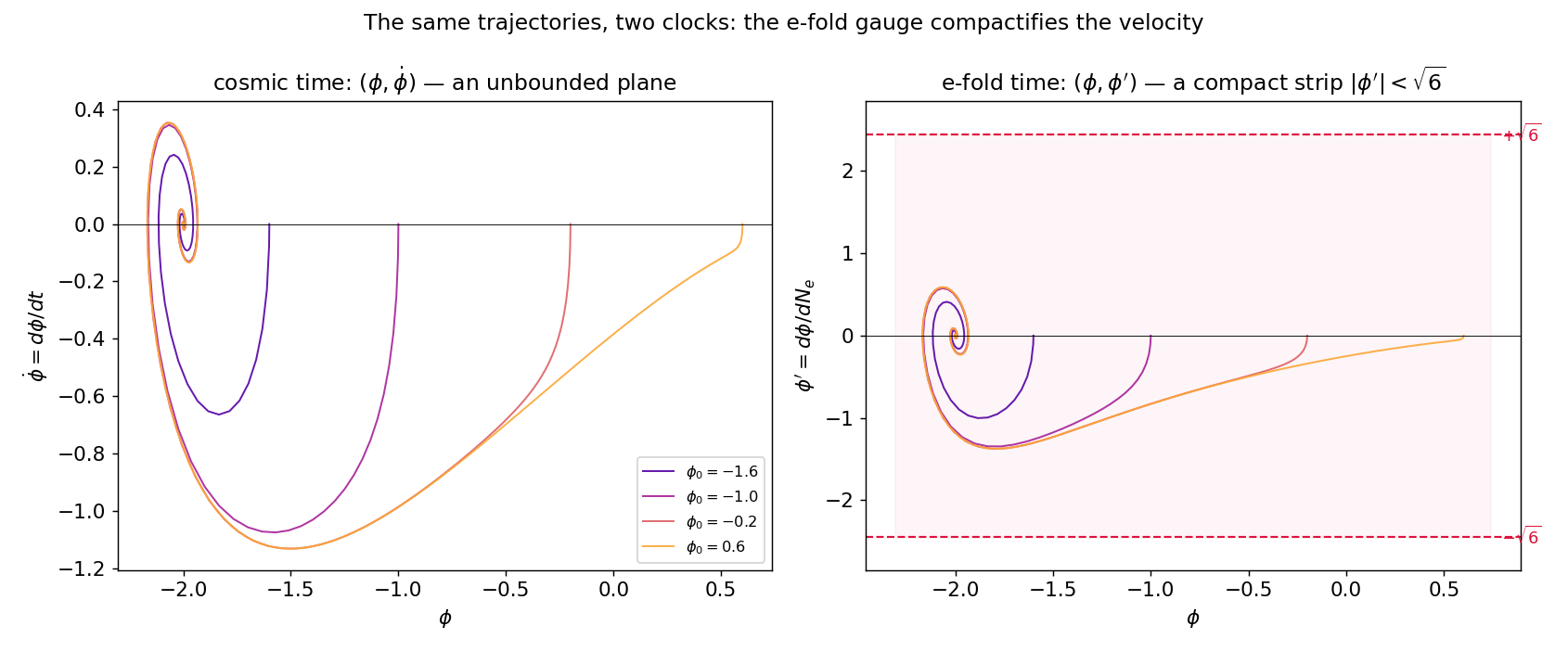
Hides: compactness, and a clean rate. The velocity is unbounded - the plane has no walls. And while the Friedmann constraint fixes algebraically, so the physical phase space is the same two dimensions the e-fold gauge uses, does not go away: it stays inside the vector field as the square root , so the Hubble drag wears an awkward root of the state. The e-fold gauge’s real gift (next section) is that drops out of the equations of motion altogether - the flow becomes scale-invariant - which is the same fact, seen dynamically, that Part 1 called the system’s dynamical similarity.
3 Conformal time ()
Defined by , so that .
Reveals: causal structure. Light cones are straight, and the mode equation for perturbations, , takes its cleanest form here. Conformal time is the native clock of the Power Spectrum of density fluctuations, the main observable in CMB physics.
Hides: the expansion rate, which is now buried in the conformal factor rather than worn on the sleeve. Good for what light does; awkward for how fast the universe grows.
4 E-fold time (, )
The workhorse of this series, and the one this note is really about. Take the number of e-folds as the clock, so , and measure velocity per e-fold, . The scalar equation becomes
| (2) |
Eliminating this way leaves an autonomous flow on the plane , so fixed points, basins, and phase portraits all become legal - which is what makes the Itzhaki–Kovetz capture a dynamical statement. (Cosmic time, once its own is solved away by the Friedmann constraint, is an autonomous planar flow too; autonomy is not the e-fold gauge’s alone.) What is special to this clock is three things, and the later posts spend all three:
-
1.
The Hubble rate drops out. Where cosmic time keeps inside the vector field, the e-fold equation contains no at all: the flow on is completely independent of the expansion rate, which is recovered only afterward as a derived quantity, . One phase portrait therefore serves every energy scale at once - scale invariance made dynamical. This is the same fact Part 1 called the system’s dynamical similarity11 1 the overall size of is invisible to the trajectory, now wearing its equation-of-motion clothes.
-
2.
A compact velocity. The Friedmann constraint becomes , so : the whole of velocity space is squeezed into a bounded strip (Fig. 1). The unbounded -plane of cosmic time and the bounded -strip hold the same trajectories.
-
3.
Tidy friction. The Hubble drag becomes the state-dependent coefficient : the object that, in Part 3, turns out to be the signature of a contact geometry.
Hides: the edge of its own validity. The clock ticks , so it stops when expansion stops, ; and the strip wall is kination, the moment the field’s energy goes all-kinetic. Both are coordinate features, not physics, but you cannot tell that from inside the e-fold gauge, which is the entire subject of Part 4.
5 The field itself ( as clock)
One can also let the inflaton be the clock, choosing so that . This is the quiet gauge behind the separate-universe and pictures of perturbations: while rolls monotonically it labels the slicing beautifully.
Hides: it dies the instant the field turns around, . At any oscillation or turning point the field simply stops being a clock. A useful reminder that a clock can fail not by running fast or slow but by ceasing to be monotonic.
6 A second choice: the velocity variable
Even after the clock is fixed, the coordinate on velocity is a further choice, and the same three appear. Cosmic time hands you ; the e-fold gauge naturally uses ; and one can trade the awkward wall at for an infinite line by the rapidity , which also flattens the friction. That is the change of variable Part 3 leans on. When the e-fold gauge finally breaks at a zero-energy vacuum, the cure in Part 4 is just to fall back on , the one velocity that stays smooth through kination.
7 The moral, and the road ahead
Every clock here describes one and the same universe; the differences are in what each makes easy and what each cannot see. Cosmic time is safe and dull; conformal time owns causal structure and the spectrum; e-fold time buys a compact, autonomous phase space, the arena in which the inflaton’s capture geometry becomes visible, at the cost of a wall it mistakes for an edge of the world. Part 3 moves into that arena and finds real, rigid geometry waiting in it. Part 4 walks the field straight into the wall, watches the gauge fail, and repairs it by giving back the one thing e-fold time threw away: the Hubble rate.
Companion posts. Part 1, The constraint behind the clock (why the lapse is gauge); Part 3, A tight little universe (the contact geometry the e-fold gauge exposes); Part 4, Where the clock stops (repairing the wall). Figure reproducible from script-archive/2026-07-13-contact-foliation/fig_clocks.py. The e-fold reduction and its scale-invariance are Sloan’s (arXiv:1803.04472, 1907.08287).