Abstract
In part Part 2 we landed on the e-fold gauge, and the inflaton reduced to a flow on the plane . In this post we ask whabout the geometry that flow carries. Eliminating the Hubble rate (Part 1) has turned the friction of an expanding universe into the signature of a contact structure: the odd-dimensional home of dissipative dynamics. This study involves a concrete question: released from rest at different heights, does the field trace back to a single origin through each phase point? It does, unless the field turns around, and the underdamped well that breaks this foliation looks like the perfect place to hunt for exotic contact topology, an overtwisted disk. We hunt and fail, instructively: a change of velocity variable exposes the reduced system as contact-Hamiltonian flow on the standard tight , the entire potential packed into the Hamiltonian. The geometry is universal and rigid; every scrap of physics lives in . That is the reduction’s payoff: and it holds everywhere but the one boundary, kination, where Part 4 will watch it come apart.
1 A simple question about starting from rest
Take a scalar field, the inflaton, rolling on a potential in an expanding universe. Let it go from rest at some height and watch where it goes. Now do it again from a different height.
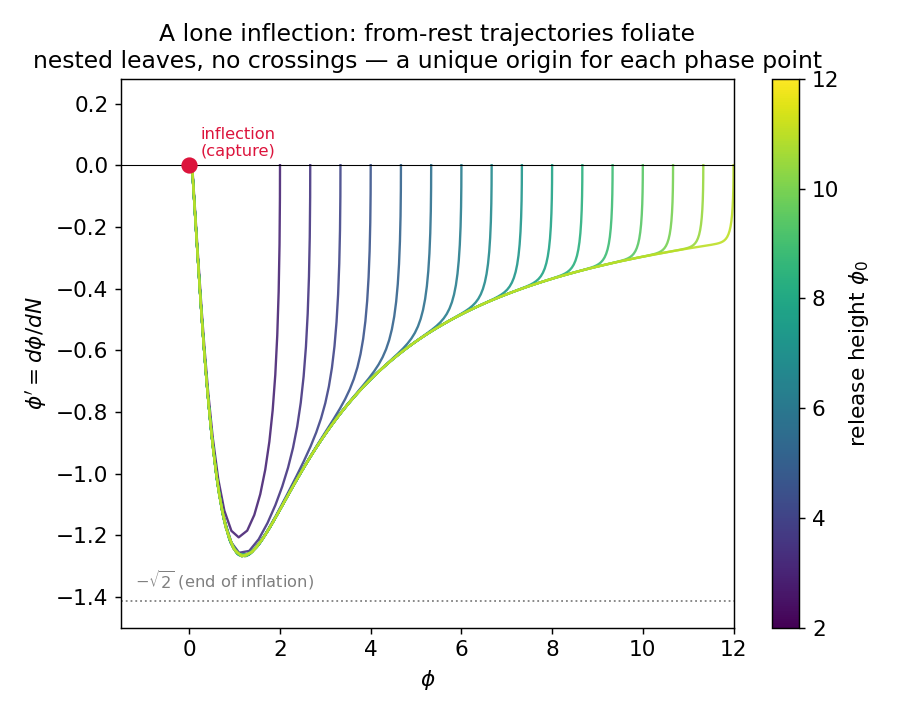
Here is a question that sounds easy: given a point in the field’s phase space, is there exactly one release height whose trajectory passes through it? Or can two different starts funnel to the same place, so that “where the field is and how fast it moves” forgets where it began? This is the question of whether a family of trajectories foliates-tiles phase space, one leaf through each point-or whether the leaves pile up. It has a crisp answer, and chasing it leads somewhere unexpected: contact geometry, a naive hunt for an overtwisted-disk, and a small surprise about how reassuringly rigid the inflaton’s phase space really is.
2 Why phase space, and why second order is no obstacle
We work in the e-fold gauge that Part 2 singled out, the number of e-folds as the clock, velocity measured per e-fold, in which the equation of motion is
| (1) |
The friction term is the Hubble drag after the Hubble rate has been eliminated; hold onto it.
Plot solutions as curves over time and they cross constantly: in configuration space there is no foliation at all. The fix is the one every dynamicist reaches for: go to phase space . A second-order equation is a first-order system on the two-dimensional plane of position and velocity,
| (2) |
The order of the equation is nothing but the dimension of the phase space. Now the Picard–Lindelöf theorem applies: as long as the right-hand side is smooth: here , so that does not blow up: there is a unique solution through each phase point. Uniqueness is exactly what second order wants: Newton needs position and velocity to fix a trajectory, and that pair is a point in phase space. The velocity coordinate is precisely the room needed to un-cross the tangles of configuration space.
For an autonomous planar system, uniqueness has a beautiful corollary: orbits never cross. Two orbits sharing a point are the same orbit. So phase space is always foliated by orbits for any smooth potential.
3 So when does the foliation actually break?
If orbits never cross, what could go wrong with our release-from-rest question? Only this: a single orbit could touch the rest axis twice. Then two release heights sit on one orbit, and downstream points are reached from both-the map from release height to phase point is no longer one-to-one. An orbit re-touching means the velocity vanished, reversed, and vanished again: a turning point. So
the release-from-rest foliation breaks if and only if the field turns around.
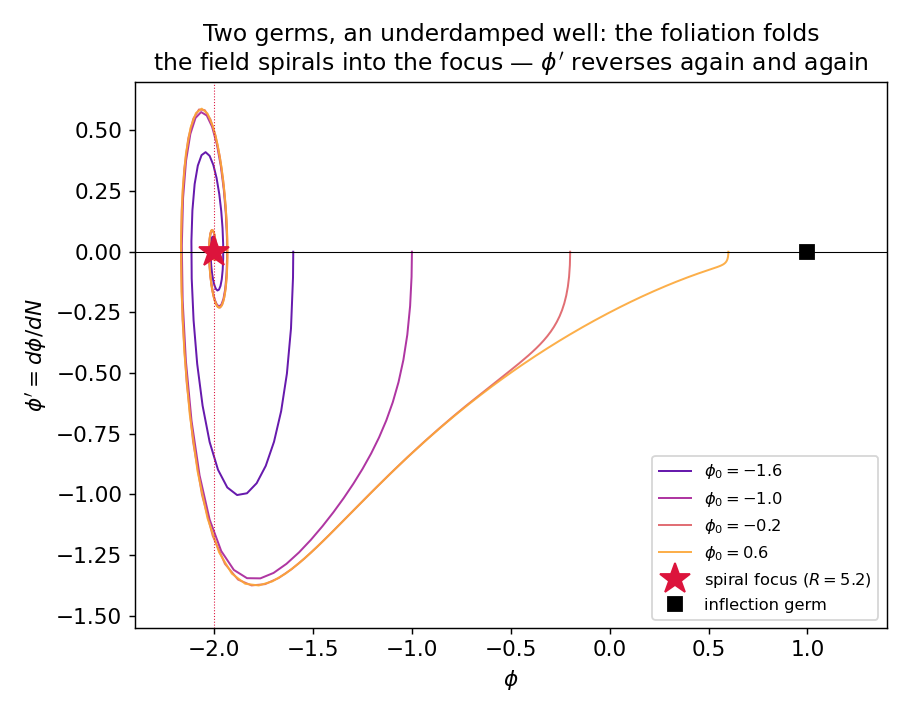
When does a rolling field turn around? It must be pushed back: it needs a potential well to fall into and overshoot. And not just any well: an underdamped one. In the thick Hubble friction of an expanding universe a shallow well is approached monotonically; overshoot requires the well’s curvature to beat the friction,
| (3) |
A pure inflection point, a lone fold, the flattest inflaton potential there is, has no such well, and the field never reverses in the physical region (Fig. 1). To break the foliation you must add structure. The cleanest way is two inflections at once, which in catastrophe language is a cusp () resolved into two folds (), with a genuine minimum between them.
4 The contact temptation
Here it gets interesting. That friction term is no friend of a symplectic structure: a frictionless mechanical system lives on an even-dimensional, energy-conserving symplectic phase space, and dissipation breaks that. The natural home for a damped system is one dimension up: a contact manifold, odd-dimensional, the geometry of thermodynamics and of Hamilton–Jacobi theory, and the standard modern setting for dissipative dynamics [1, 2]. The reduced cosmological phase space is contact. This is the reduction Part 1 built, eliminating from the constrained system, and the friction is the signature.
Contact structures come in two flavors, and the distinction is deep [6]. A contact structure is tight if it is rigid and geometric. Otherwise it contains an overtwisted disk, a small embedded disk along whose boundary the contact planes make a full turn. Overtwisted structures are flexible, classified entirely by algebraic topology [5], with no interesting geometry left; tight ones are where the geometry lives. So a natural, greedy question: if and when is the inflaton’s contact structure overtwisted? And if so, is an underdamped, spiralling well-exactly the thing that breaks our foliation-where the overtwisted disk hides? A spiral is rotation; rotation twists planes; enough twist is an overtwisted disk. The two germs seemed like the perfect place to look (Fig. 2).
5 The hunt, and a Darboux-shaped wall
The spiral is real. Numerically the well becomes a spiral focus exactly when : the same threshold (3) that breaks the foliation. One condition, two hats: turning point and spiral focus are the same event.
But there is a wall, and it is called Darboux’s theorem [6]: every contact structure looks locally like the one standard model. Overtwistedness is never a local property: you cannot find an overtwisted disk by staring at a neighborhood of the spiral, no matter how tightly it winds. If a disk exists it is a global object, built from how the contact planes are glued across the whole two-germ landscape. To settle it, we need the global contact form.
6 The reparametrization that clears the fog
Writing the global form runs into the friction: the obvious form is not preserved by the flow, because the state-dependent coefficient injects terms it cannot absorb. That coefficient is really a gauge artifact: the velocity looks bounded, , only because we clock by e-folds.
So change the velocity variable. Write it as a rapidity, . Then exactly, and in the equation of motion it cancels:
| (4) |
Two things happen. The friction factor vanishes from the velocity equation. And the kination boundary , where the contact structure degenerated, maps to : it was a coordinate horizon of the e-fold clock, and rapidity sends it to infinity where it belongs. (Both facts check to eight digits.)
Now take the slow-roll heart of the dynamics, small, where inflation happens. The system becomes, back in ,
| (5) |
and this is exactly a contact-Hamiltonian system [1]:
| (6) |
One checks and ; it matches the full system wherever is small, the discarded living only on the fast-roll plunge.
7 The punchline: the geometry cannot see the potential
Look at where the potential went in (6): appears only in the Hamiltonian , never in the contact form . The contact structure is
| (7) |
the standard contact structure on , which Bennequin proved is tight [4]. It is the same for every potential: one germ, two germs, a well, a spiral, the whole ADE zoo. The potential shapes the flow inside a fixed, universal, tight geometry; it does not, and cannot, twist the structure.
So the honest answer to the hunt is no. The two-germ well hosts no overtwisted disk, because overtwistedness is a property of , and is blind to . The spiral we found is a focus of the flow, not a twist of the structure-a perfectly tight geometry is entirely happy to carry a spiralling contact-Hamiltonian flow. We went looking for exotic topology and found the tightest, most standard geometry there is.
One loophole I will not paper over: this is proven where the contact structure is exact, the slow-roll bulk. The full flow, with its fast-roll friction, is not contact-Hamiltonian for this ; the obstruction lives out near the kination horizon . Whether some exotic global form lurks there and is overtwisted, we have not ruled out, but that is the gauge boundary, outside inflation, with no positive reason to expect it. That boundary, where the field kinates and the reduction genuinely comes apart, is exactly where Part 4 goes.
8 Why the negative is the point
The detour hands back a clean way to say what the cosmological contact structure is: FLRW scalar-field dynamics is contact-Hamiltonian flow on the standard tight , with the entire potential, inflection points, catastrophe unfoldings, all of it, packed into , and the friction coefficient set by the three spatial dimensions. The geometry is universal and rigid; every scrap of physics is in the Hamiltonian.
There is a smaller lesson, too. The condition that breaks the trajectory foliation (), the condition that makes a spiral focus, and the condition that governs whether a field oscillates after inflation are one condition, , seen from three sides. And the boundary where the tidy contact picture frays is not a real edge of physics: it is the horizon of the clock we chose to read. Mind your gauge.
Note. Contact-Hamiltonian mechanics of dissipative systems is standard [1, 2], with cosmology among its cited applications; I have not found the specific statement that the reduced inflaton system is the standard tight structure with entirely in . Treat (6) as, at most, a new repackaging pending a proper survey, not a claimed theorem. Figures regenerate from script-archive/2026-07-13-contact-foliation/.
References
- [1] A. Bravetti, H. Cruz, D. Tapias, Contact Hamiltonian Mechanics, Ann. Phys. 376 (2017) 17–39, arXiv:1604.08266.
- [2] M. de León, M. Lainz, A review on contact Hamiltonian and Lagrangian systems (2020), arXiv:2011.05579.
- [3] J. Gaset, M. Lainz, A. Mas, X. Rivas, The Herglotz variational principle for dissipative field theories (2022), arXiv:2211.17058.
- [4] D. Bennequin, Entrelacements et équations de Pfaff, Astérisque 107–108 (1983) 87–161.
- [5] Y. Eliashberg, Classification of overtwisted contact structures on 3-manifolds, Invent. Math. 98 (1989) 623–637.
- [6] H. Geiges, An Introduction to Contact Topology, Cambridge Studies in Advanced Mathematics 109, Cambridge University Press (2008).