Abstract
We built the tight contact picture of Part 3 in the e-fold gauge, whose one blind spot (Part 2) was a wall at kination. In this installment, we walk the field straight into it: set the potential to zero at its minimum and watch the reduced description fail. The velocity slams into , the slow-roll force diverges, the foliation and the contact structure break. And yet, in cosmic time, the field is just a damped oscillator settling smoothly into a Minkowski background. The analytic mayhem is entirely gauge-dependent. The cure closes the series: give back the Hubble rate: un-reduce to the constrained system of Part 1.
1 Tuning the vacuum to zero
Take the two-germ well of Part 3, the cusp resolved into a fold and a local minimum, and tune the additive constant so that at the global minimum. Physically this is a universe with no cosmological constant: the field’s ultimate resting place has exactly zero vacuum energy, and the endpoint of the story is empty Minkowski space rather than eternal de Sitter. It sounds like the most innocent choice in the world. In the e-fold gauge it is anything but.
2 Three things break at once
At a zero-energy minimum both and , so near it with , and the object the reduced dynamics actually feels is
| (1) |
The slow-roll force diverges; the slow-roll parameter . There is no slow-roll approach to a zero-CC vacuum. The naive attractor velocity would need to exceed , which is forbidden. Meanwhile : the clock
| (2) |
slows to a stop, and the minimum sits exactly on the boundary where, in Part 3, the foliation and the contact structure were already known to degenerate.
Worse, the field visits the wall. The Friedmann constraint reads , so at the very bottom, where ,
| (3) |
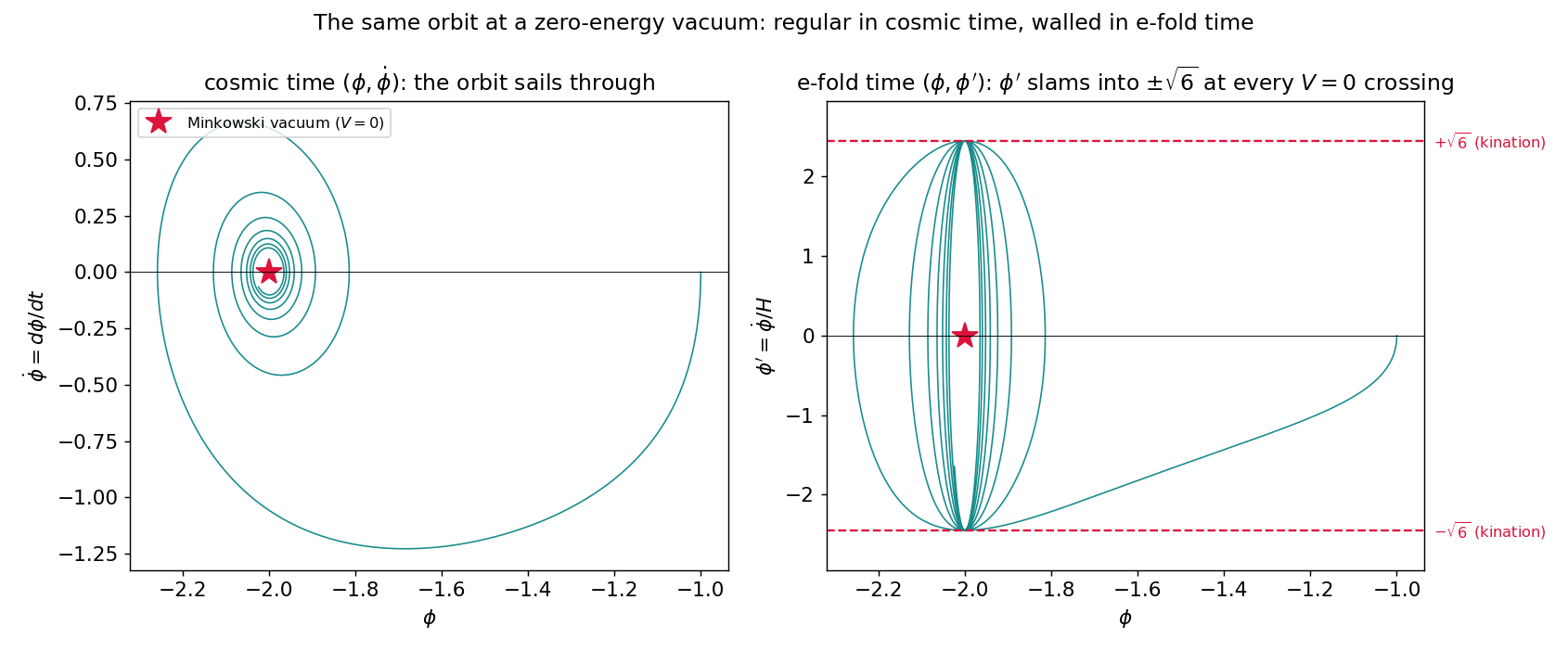
Each pass through the vacuum is an instant of pure kination, equation of state , and the e-fold description hits its ceiling. The tidy spiral focus of Part 3 degenerates as : infinitely underdamped, winding without bound, the coherent oscillations redshifting as matter (). The field is ringing down into a genuine minimum - the matter-dominated aftermath that reheating would ride on11 1 This is studied explicitly as the physics of “reheating”., not the inflection-point capture of the earlier posts.
3 Nothing actually happened
Now look at the same orbit in cosmic time (Fig. 1, left). It is a damped harmonic oscillator,
| (4) |
with smooth through every crossing and finite and positive at the bottom. The field simply oscillates, loses amplitude to Hubble friction, and settles. There is no singularity in the physics. Every dramatic symptom of the previous section, the diverging , the wall at , the broken foliation, is a feature of the coordinates and , not of the trajectory. This is the sharpest form of the series’ moral: a coordinate singularity is not a singularity of the world.
4 The wrong rescue, and the right one
The tempting fix is the change of variable that tamed the wall in Part 3: the rapidity , which sends . It does not help here. That gauge is built to keep you away from the wall, and the zero-CC field reaches it, so the crossing becomes a blow-up: near a bottom-crossing at , in finite e-fold time. Sending the wall to infinity does not remove a crossing the physics insists on making, it relocates it22 2 and the rapidity leaves the divergence of untouched.
The right move is not another reduction but the opposite of one. Notice what is actually sick: not , which is finite at kination, but the reduced velocity , which we manufactured back in Part 1 by using the Friedmann constraint to eliminate . So put back. Return to the Gibbons–Hawking–Stewart symplectic system of Part 1: restore the scale factor and its momentum as independent variables, evolve in cosmic time, use . In this case, the wall is simply not there. The contact three-manifold was the constraint surface with solved for; un-reducing lifts you off it, back onto the parent we started the series on. The zero-energy vacuum is precisely the locus where the contactsymplectic reduction is singular, so it is exactly where you must undo it. At zero cosmological constant, you have to give back.
5 The edge of the world, and the edge of a chart
There is a reason this particular vacuum is where the reduction fails. A minimum with is a de Sitter point: residual vacuum energy, eternal acceleration, bounded below: the reduced description never approaches its wall. A minimum with collapses. The marginal case, , is the razor between them, and it is the one that runs the field straight into . So the place the e-fold gauge breaks is not arbitrary: it is the boundary of the cosmological attractor landscape, seen from inside a chart that cannot represent it. Mind your gauge, and the boundary turns out to be an ordinary Minkowski vacuum reached by ordinary reheating.
6 Closing the loop
That completes the round trip the series set out to make. Part 1 found a constrained symplectic system with no preferred time. Part 2 chose a clock. Part 3 eliminated to reduce that system to a contact geometry and found real, rigid structure inside it. And Part 4 rode the reduction to its one boundary, watched it fail, and repaired it by giving back, landing exactly where we began. The contact picture is a beautiful and useful shadow; but it is a shadow, and knowing which of its features are the object and which are the projection is the whole discipline.
Companion posts. Part 1, The constraint behind the clock; Part 2, The choice of clock; Part 3, A tight little universe. Figure reproducible from script-archive/2026-07-13-contact-foliation/fig_kination.py. Sloan’s continuation of the reduced FLRW flow through the big-bang singularity (arXiv:1907.08287) is the natural place to ask whether his and our are the same locus - an open question worth its own note.