In the last post we met the icosians: a ring of quaternions with golden-ratio coordinates, whose 120 elements of norm \(1\) form the binary icosahedral group \(2\cdot A_5\), the double cover of the icosahedron's rotation group. I promised that these same 120 quaternions seed the \(E_8\) lattice, and this post illustrates how. As it turns out, \(E_8\) shows up by two distinct routes that look nothing alike, from the very same 120 numbers.
What the \(E_8\) Lattice is
\(E_8\) is the largest exceptional simple Lie group. Its roots lie on an eponymous lattice in \(8\)-dimensional space - a discrete grid of points - and it is exceptional on almost every axis you can name:
- It is the unique even unimodular lattice in dimension \(8\).1
- Its shortest nonzero vectors all share the same length. There are 240 of them, and each makes a \(60^\circ\) angle with \(56\) of the others.
- It gives the densest packing of spheres in eight dimensions, a fact only proved in 2016.6 Its kissing number - how many balls can touch one central ball - is \(240\), also optimal.
Notably that number, \(240\), is twice the count of unit icosians.
Because it's so gorgeous, here is the whole root system, flattened from eight to two dimensions along its most symmetric plane:
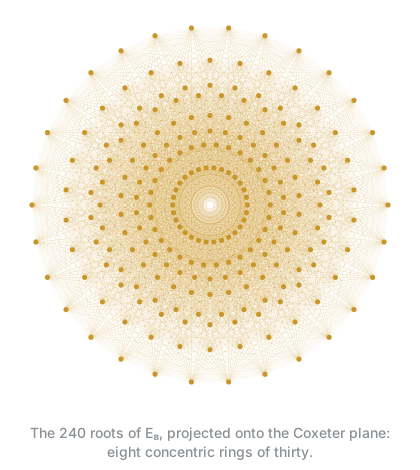
The eightfold structure of \(8\) concentric rings of \(30\) points.
To flatten eight dimensions onto two you have to choose a plane, and there is one canonical choice: Multiply all eight of the generators of \(E_8\)'s Weyl group together and you get its Coxeter element \(w\), an element of order \(h = 30\).3 Among all the planes in \(\mathbb{R}^8\) there is exactly one on which \(w\) acts as an honest rotation - by \(2\pi/30\), twelve degrees - and that is the plane the figure projects onto. It is not the prettiest plane; it is the only one where the symmetry of the thing survives being squashed.
Everything else follows. \(w\) shuffles the \(240\) roots among themselves, so take one root and apply \(w\) over and over: its shadow in the plane spins by \(12^\circ\) each time, staying at the same radius, and after thirty steps it comes home. Thirty points, one radius, evenly spaced - a regular \(30\)-gon. Each ring is one orbit, caught in the act. And no root ever comes home early,5 so every orbit is a full thirty and the rings must number
which is the rank of \(E_8\), and the count of dimensions we started with. The rings are \(30\) because \(w\) has order \(30\); there are \(8\) of them because \(240 = 8 \times 30\); and the \(30\)-fold symmetry you see at a glance is nothing but the Coxeter element, drawn. We shall revisit this structure in more detail in the next piece in this series.
But first, here are two ways to find \(E_8\) from the icosians.
Route 1 - the icosian ring is \(E_8\)
Two Groups of Units
Recall from last time that the Hurwitz integers form a four-dimensional analog of integers \(\mathbb{Z}\) based on the \(\mathbb{Z}\)-span of a collection of 24 unit quaternions. These numbers give the quaternions, \(\mathbb{H}\), a true analog as, for example, the Hurwitz integers can be uniquely factorized into primes4.
We met the icosian ring that was similarly generated from 120 unit icosians, 24 of which are those same Hurwitz units.
In a footnote we observed that there were actually two, dual constructions, depending upon whether you elected to have the 96 even or odd permutations of the golden units like
and that essentially amount to taking all even permutations of the above or that same set multiplied by \(\phi\). Each family closes into its own copy of \(2\cdot A_5\).
What we cannot do is take both families at once. Throw the even and odd units into a single set and ask for the group they generate, and closure fails - the product of an even unit and an odd one is neither - and they multiply out to an infinite set, dense in \(S^3\), exactly as the footnote warned last time.
On its own every unit icosian rotates through an angle commensurate with a full turn: its real part is one of \(0, \pm\tfrac12, \pm\tfrac{\phi}{2}, \pm\tfrac{1}{2\phi}\). Each the cosine of a rational multiple of \(\pi\) - which is exactly why each family closes into a finite group. Multiply an even icosian by an odd one, though, and \(\phi\) meets its conjugate in the real part and lands on an irrational value \(a + b\phi\).
By Niven's theorem that is no longer the cosine of any rational angle, so the product is a rotation by an irrational multiple of \(\pi\), whose powers circle the sphere forever without repeating - coming back arbitrarily close to the identity, gaps shrinking past any bound.
From Groups to Rings
These two distinct sets of 120 unit icosians, differing by a factor of \(\phi\), generate isomorphic groups. As we shall see now, taken together, these 240 items correspond to the 240 minimal length vectors of the \(E_8\) lattice.
Let \(I\) be the set of icosians derived from the even permutations, and let \(I^{\prime}\) be their odd counterparts. The \(\mathbb{Z}\)-span of either form an instance of the ring of icosians,
Treated as a subset of the quaternions, either ring forms a rank-4 \(\mathbb{Z}[\phi]\) module or a rank-8 \(\mathbb{Z}\) module, as \(\phi\) is an irrational number.
In other words, for each \(q\) in \(\mathcal{I}\), we may write
with \(a_{m}\) and \(b_{m}\) each in \(\mathbb{Z}\) so that
Hence for each \(q\) there are four independent choices of \(\mathbb{Z}[\phi]\) integers, or eight such choices of \(\mathbb{Z}\) integers.
From Rings to Lattices
The quaternions themselves serve as a vector space on which the group \(I\) can act as a finite subgroup of the unit quaternions, also known as the group rotations, \(S^{3}\).
Modules of rings are akin to representations of groups, so it is natural to ask if and to what extent \(\mathcal{I}\) can also act on this representation.
As a rank-4 \(\mathbb{Z}[\phi]\)-module, this amounts to embedding \(\mathcal{I}\) directly into the four-dimensional \(\mathbb{H}\). With a suitable choice of an inner product, this embedding becomes a lattice in \(\mathbb{H} \cong \mathbb{R}^{4}\). This embedding is fairly straightforward as \(\mathbb{Z}[\phi]\) embeds in \(\mathbb{R}\). The only quirk - which is worth noting - is there are actually two such embeddings or places in \(\mathbb{R}\), one given by \(\mathcal{I}\) and one given by the Galois conjugate, \(\mathcal{I}^{\prime}\).
This matters insofar as we try to find a home for \(\mathcal{I}\) as a rank-8 \(\mathbb{Z}\)-module in \(\mathbb{R}^{8}\). While it is true that \(\mathbb{Z}^{8}\) does embed in \(\mathbb{R}^{8}\), this naive embedding folds, as \(a_{m} +\phi b_{m}\) also serves as a real number.
The full rank-8 structure of \(\mathcal{I}\) emerges as a lattice in \(\mathbb{R}^{8}\) only by including both places for \(\phi\) in \(\mathbb{R}\). That is, we deploy the Minkowski construction where
To complete this construction, we need an inner product on \(\mathbb{R}^{8}\) built from this map - and the two places must be weighted unequally, the \(\phi\)-place by \(1/\phi\) and the conjugate \(\phi'\)-place by \(\phi\):
where \(\langle q, p\rangle_{\mathbb{H}} = \mathrm{Re}(q\bar p)\) is the ordinary dot product on \(\mathbb{H}\cong\mathbb{R}^4\). The associated norm is
Previously we saw that including both units in \(I\) and \(I^{\prime}\) gave an infinite group that was dense in \(S^{3}\), rather than either of the 120-element finite groups. You might wonder why this construction then gives a discrete lattice and now a similar swarm of points.
The answer is simple when viewed from the inner product. The arithmetic of each place is kept separated, and the irrational parts are normalized away when they are combined. The norm of any element \(q\) is therefore restricted to \(\mathbb{Z}\).
Let us see this explicitly. The quaternionic norm gives a quadratic form in \(\mathbb{Z}[\phi]\):
Hence, there are nonnegative integers \(a\) and \(b\) such that
and similiarly
as Galois conjugation maps \(\mathcal{I} \leftrightarrow \mathcal{I}^{\prime}\) via \(\phi \leftrightarrow \phi^{\prime}\).
Hence
The minimum nonzero value of \(Q\) is \(2\), reached by exactly \(240\) points: the \(120\) unit icosians of \(I\) at norm \(|q|^2 = 1\), and the \(120\) golden units of \(I'\), their \(\phi\)-scaled partners. That is the \(240 = 120 + 120\) we flagged at the start - twice the unit icosians - and they are precisely the \(240\) roots of \(E_8\).
Route 2 - McKay's correspondence
Now let's forget lattices entirely and count representations instead.
The norm-\(1\) quaternions form the group \(\mathrm{SU}(2)\),10 so the 120 unit icosians are a finite subgroup \(G = 2\cdot A_5 \subset \mathrm{SU}(2)\). To pull \(E_8\) out of this we need a little of the language of representations.
A representation of a group turns each group element into a matrix: a linear map on some vector space. Hence composing symmetry transformations amounts simply to multiplying matrices. A representation is irreducible if the vector space on which the matrices act contains no smaller subspace the group independently preserves. The irreducible ones are the atoms, and every other representation is a molecule made from them.
Now attached to each representation is its character, \(\chi\): the function sending each group element to the trace of its matrix. A representation of a finite group is entirely determined - up to isomorphism - by its character.11 Here are two remarkable facts about characters of finite group representations:
The first checks irreducibility. Think of \(\chi\) as a \(|G|\)-dimensional vector and average the square of a character over the group:
This equals \(1\) precisely when the representation is irreducible; and if the representation instead breaks into \(k\) distinct irreducible pieces, the average comes out to \(k\).13 One number tells us whether we are holding an atom - and if not, how many atoms it is.
The second is a completeness check: the dimensions \(d_1, d_2, \ldots\) of all the irreducible representations satisfy
This is true for any finite group; there is only ever a finite collection of irreducible representations to find.
The 120 real parts
Here is where the icosians shine.
Hopefully it's clear that a unit quaternion can be written \(q(\theta) = \cos \theta + (\sin \theta)\,\sigma\) for some unit imaginary \(\sigma\). Since \(\sigma^2 = -1\), that unit imaginary is already playing the role of \(i\), and the quaternion is an honest exponential:
Read as a matrix in \(\mathrm{SU}(2)\), \(\sigma\) becomes a traceless anti-Hermitian matrix with eigenvalues \(\pm i\), so \(q(\theta)\) has eigenvalues \(e^{\pm i \theta}\) and trace \(2\cos \theta\).
Take the 120 unit icosians and read off their real parts. These take only nine distinct values, and here is how the 120 elements distribute across them:
| \(\cos \theta\) | \(1\) | \(\phi/2\) | \(1/2\) | \(-\phi'/2\) | \(0\) | \(\phi'/2\) | \(-1/2\) | \(-\phi/2\) | \(-1\) |
|---|---|---|---|---|---|---|---|---|---|
| \(\theta\) | \(0\) | \(\pi/5\) | \(\pi/3\) | \(2\pi/5\) | \(\pi/2\) | \(3\pi/5\) | \(2\pi/3\) | \(4\pi/5\) | \(\pi\) |
| count | \(1\) | \(12\) | \(20\) | \(12\) | \(30\) | \(12\) | \(20\) | \(12\) | \(1\) |
This little table is the entire input to everything that follows, and it is essentially the character of the tautological representation: \(G\) sits inside \(\mathrm{SU}(2)\) acting on \(\mathbb{C}^2\), and we will call that \(2\)-dimensional representation the \(\mathbf{2}\).
Building The Irreps of \(2\cdot A_{5}\).
\(\mathrm{SU}(2)\) has exactly one irreducible representation in each dimension \(n = 1, 2, 3, \ldots\) - the spin-\(\tfrac{n-1}{2}\) representations of quantum mechanics. Write \(\chi_n\) for the character of the \(n\)-dimensional one. Weyl's formula gives it in closed form: on an element whose trace is \(2\cos \theta\),
For \(n = 2\) that reads \(2\cos \theta\), the trace itself, since the \(2\)-dimensional representation of \(\mathrm{SU}(2)\) is the matrix you started with.14
Now restrict one of them to \(G\). Nothing about the representation changes - same vector space, same matrices. We simply stop asking what all of \(\mathrm{SU}(2)\) does and ask only what the \(120\) icosians do. This amounts to evaluating it at only the nine discrete values of \(\theta\) we have already determined.
| \(\theta^{\star}\) | \(0\) | \(\pi/5\) | \(\pi/3\) | \(2\pi/5\) | \(\pi/2\) | \(3\pi/5\) | \(2\pi/3\) | \(4\pi/5\) | \(\pi\) |
|---|---|---|---|---|---|---|---|---|---|
| \(\chi_1\) | \(1\) | \(1\) | \(1\) | \(1\) | \(1\) | \(1\) | \(1\) | \(1\) | \(1\) |
| \(\chi_2\) | \(2\) | \(\phi\) | \(1\) | \(-\phi'\) | \(0\) | \(\phi'\) | \(-1\) | \(-\phi\) | \(-2\) |
| \(\chi_3\) | \(3\) | \(\phi\) | \(0\) | \(\phi'\) | \(-1\) | \(\phi'\) | \(0\) | \(\phi\) | \(3\) |
| \(\chi_4\) | \(4\) | \(1\) | \(-1\) | \(-1\) | \(0\) | \(1\) | \(1\) | \(-1\) | \(-4\) |
| \(\chi_5\) | \(5\) | \(0\) | \(-1\) | \(0\) | \(1\) | \(0\) | \(-1\) | \(0\) | \(5\) |
| \(\chi_6\) | \(6\) | \(-1\) | \(0\) | \(1\) | \(0\) | \(-1\) | \(0\) | \(1\) | \(-6\) |
| \(\chi_7\) | \(7\) | \(-\phi\) | \(1\) | \(-\phi'\) | \(-1\) | \(-\phi'\) | \(1\) | \(-\phi\) | \(7\) |
| count | \(1\) | \(12\) | \(20\) | \(12\) | \(30\) | \(12\) | \(20\) | \(12\) | \(1\) |
Now the irreducibility test can run. It averages \(\chi(g)^2\) over all \(120\) icosians - but \(\chi\) takes the same value on every icosian of a given trace, so that sum collapses to nine terms, each weighted by how many icosians carry that trace:
As an exercise you can show that
That is,
| \(n\) | \(1\) | \(2\) | \(3\) | \(4\) | \(5\) | \(6\) | \(7\) |
|---|---|---|---|---|---|---|---|
| \(\langle \chi_n, \chi_n\rangle\) over \(G\) | \(1\) | \(1\) | \(1\) | \(1\) | \(1\) | \(1\) | \(\mathbf{2}\) |
At \(n=7\) specifically, things take a turn. The representation associated with \(\chi_7\) is reducible. The first six rungs of \(\mathrm{SU}(2)\)'s ladder restrict to \(G\) irreducibly. \(G\) inherits them untouched, of dimensions \(1, 2, 3, 4, 5, 6\) - including the trivial representation \(\mathbf{1}\) and \(\mathbf{2}\) itself. And then it stops.
The seventh rung breaks - as we just watched it do. Two atoms, not one. Their dimensions must add to \(7\), and two more inner products settle which two:
Neither the \(\mathbf{3}\) nor the \(\mathbf{4}\) we already hold appears in it. So the pieces are a new \(3\) and a new \(4\), and we write them as \(\mathbf{3b}\) and \(\mathbf{4b}\)12
One more rung finishes the job. The \(8\)-dimensional representation splits in two as well, but this time \(\langle \chi_8, \chi_6\rangle = 1\): one piece is the \(\mathbf{6}\) we already have, so the other has dimension \(2\) - and it is orthogonal to our \(\mathbf{2}\), so it is a new \(\mathbf{2b}\):
That is nine irreducible representations,
and now the completeness check earns its keep:
Exactly \(|G|\). There is no room for another representation - not a big one, not a small one, not ever. We have all of them, and we got them out of the real parts of 120 quaternions.17
The graph
Now McKay's recipe, with the full list in hand. With all nine characters known this is mechanical: the character of \(\rho \otimes \mathbf{2}\) is simply the pointwise product \(\chi_\rho \cdot \chi_\mathbf{2}\) - multiply two rows of nine numbers - and the same inner product reads off the pieces.16 Nine representations, nine products:
The first five are the spin ladder doing what it always does: \(\mathbf{2} \otimes \mathbf{n} = (\mathbf{n{-}1}) \oplus (\mathbf{n{+}1})\), one rung down and one rung up.15 Each of those dots links to the two beside it - except the \(\mathbf{1}\) at the bottom, which has no rung below and so links only upward to the \(\mathbf{2}\). A chain, climbing \(1, 2, 3, 4, 5, 6\).
But look at the sixth. In \(\mathrm{SU}(2)\), tensoring the \(\mathbf{6}\) with \(\mathbf{2}\) gives \(\mathbf{5} \oplus \mathbf{7}\), and that is still true for \(G\) - except that the \(\mathbf{7}\) is not a representation of \(G\). It is \(\mathbf{4b} \oplus \mathbf{3b}\). So where the other dots have two neighbors, the \(\mathbf{6}\) has three. The fork in the graph and the break in the ladder are the same event, seen twice.
The last three products are the aftermath. They involve \(\mathbf{2b}, \mathbf{3b}, \mathbf{4b}\), which are not \(\mathrm{SU}(2)\) representations at all - they are the shards - so the ladder has nothing to say about them, and the character table has to be consulted directly. It reports that no new representations appear: the \(\mathbf{4b}\) picks up the \(\mathbf{2b}\), and the \(\mathbf{3b}\) and \(\mathbf{2b}\) are loose ends with nowhere to link but back. The graph closes.
Draw the edges those nine equations dictate:
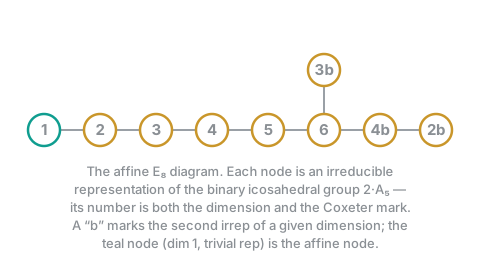
the affine \(E_8\) diagram.
Those nine dimensions - \(1,2,3,4,5,6,4,3,2\) - are exactly the marks of the affine \(E_8\) diagram, the integers that record how its highest root is built. The trivial representation sits at the far end of the long arm: it is the extra "affine" node that turns the ordinary \(E_8\) diagram (eight nodes) into its affine cousin (nine). Delete it and \(E_8\) itself is what remains.
And now add them up: \(1+2+3+4+5+6+4+3+2 = 30\). We have met that number already. Thirty is \(E_8\)'s Coxeter number - the thirty dots in each ring of the very first figure in this post. The \(240\) roots are eight rings of thirty, and the thirty is the sum of the dimensions of the icosahedral group's representations. Both of the numbers the icosians carry, \(120\) and \(30\), come out stamped on \(E_8\).
So the icosahedral group hands you the affine \(E_8\) Dynkin diagram - and \(E_8\) itself is one node away, and with it the \(E_8\) Lie algebra and its \(240\) roots. All this without ever mentioning a lattice.
One group, two \(E_8\)'s
Let's take a step back and look what we've found.
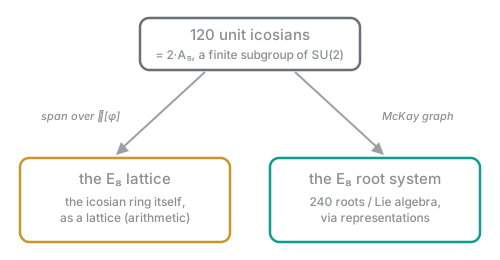
The same \(120\) unit icosians produced \(E_8\) along two paths that look nothing alike. One is pure arithmetic - unfold \(\mathbb{Z}[\phi]\) through its two real places and read off a lattice. The other is pure representation theory: multiply up the irreducible characters and read off a diagram. They share almost no machinery, yet they land on the same \(E_8\): the lattice of Route 1 is precisely the root lattice of the root system of Route 2.
Almost no machinery. Look again at what Route 2 actually ran on - a table of nine numbers, with \(\phi\) and \(\phi'\) sitting in it. And the representations that fell out come in golden-conjugate pairs: \(\mathbf{2}\) with \(\mathbf{2b}\), \(\mathbf{3}\) with \(\mathbf{3b}\). The \(\phi \leftrightarrow \phi'\) swap that unfolded the icosian ring into eight dimensions in Route 1 is the very same swap that names the fork of the diagram in Route 2. The two routes are not as disjoint as they were advertised. They are two readings of one piece of golden arithmetic - which is perhaps the real reason they were always going to agree.
Why should a group defined by the symmetries of a Platonic solid know about the densest packing in eight dimensions and the largest exceptional Lie algebra, and know that they are the same object? That coincidence has a name - the ADE correspondence - and the icosahedron is its richest case. The three numbers \(2, 3, 5\) that build the icosahedron (its rotation axes have orders \(2\), \(3\), and \(5\), through the edge-midpoints, the faces, and the vertices) are the same \(2, 3, 5\) that measure the three arms of the \(E_8\) diagram. The icosahedron was \(E_8\) in disguise the whole time.
Where this goes
The ADE pattern, once you see it here, turns up everywhere two-, three-, and five-fold symmetry does. Collapse the plane \(\mathbb{C}^2\) by the action of the binary icosahedral group and you get a single sharp singularity; resolve it - smooth it out minimally - and the pieces you introduce form eight spheres meeting in exactly the \(E_8\) pattern.18 The same diagram governs which simple Lie algebras exist, which surface singularities are "simplest," and much else. The icosahedron sits at the top of all three lists at once.
I think that's enough for now, notice how little we had to assume: golden arithmetic and the symmetries of one Platonic solid were enough to force out the most exceptional lattice in mathematics... twice!
-
A lattice is even if every vector has even squared length, and unimodular if it equals its own dual (equivalently, its defining matrix has determinant \(\pm 1\)). Even unimodular lattices exist only in dimensions divisible by \(8\); in dimension \(8\) there is a unique one, \(E_8\). ↩
-
Number theorists call these the two real places of \(\mathbb{Q}(\sqrt5)\). Note that the concrete number \(\sqrt5\) never becomes negative; it is the abstract \(\phi\) that admits two honest real readings, \(1.618\ldots\) and \(-0.618\ldots\). ↩
-
The Coxeter number \(h\) of a root system is the order of this element - \(30\) for \(E_8\), and it does not depend on which order you multiply the reflections in. It is one of those integers that shows up in six unrelated-looking places and turns out to be the same integer every time; the identity \(|\Phi| = (\text{rank}) \times h\), here \(240 = 8 \times 30\), is one such place. Keep an eye on the \(30\): it comes back at the end of this post from a completely different direction, and \(30 = 2 \cdot 3 \cdot 5\) is not a coincidence either. ↩
-
This is not true of the naive Lipschitz integers in \(\mathbb{H}\), which are just the \(\mathbb{Z}\)-spam of the units \(1,i,j,k\). This subring of \(\mathbb{H}\) fails to have the Archemedian property: for any two positive numbers \(x\) and \(y\), there exists a natural number \(n\) such that \(n\)x > \(y\), which affords a converging sense of division, and hence a unique (up to permutation of factors) prime factorization. ↩
-
An orbit could in principle close up early, if some power \(w^k\) held a root still. It never does, for a reason worth seeing. The eigenvalues of \(w\) on \(\mathbb{R}^8\) are \(e^{2\pi i m/30}\) as \(m\) runs over the exponents of \(E_8\): \(1, 7, 11, 13, 17, 19, 23, 29\) - which is to say, exactly the eight residues coprime to \(30\). So \(w^k\) can hold a direction fixed only if \(30\) divides \(k,m\) for one of those \(m\), and since none of them shares a factor with \(30\), that forces \(30 \mid k\). The count of rings is therefore \(\varphi(30) = 8\), Euler's totient function landing on the rank of \(E_8\). ↩
-
Maryna Viazovska, The sphere packing problem in dimension 8 (preprint 2016; Annals of Mathematics, 2017), part of the work for which she was awarded a Fields Medal in 2022. That \(240\) is the optimal kissing number in dimension \(8\) was known earlier (Odlyzko–Sloane / Levenshtein, 1979). ↩
-
In symbols this is the field trace of the quaternion norm, twisted: \(\mathrm{Tr}_{\mathbb{Q}(\sqrt5)/\mathbb{Q}}\big(\alpha\,N(q)\big)\) with \(\alpha = (\sqrt5-1)/\sqrt5\). The untwisted version \(|q|^2 + |q'|^2 = \mathrm{Tr}\big(N(q)\big)\) is the one you would write down first, and it genuinely fails - it is not even integer-valued on the ring, and twice it has determinant \(5^4\) rather than \(1\). The \(\sqrt5\) downstairs is the whole point: \((\sqrt5)\) is the different of \(\mathbb{Q}(\sqrt5)\), and twisting a trace form by the inverse different is the standard device for making it unimodular. Twisting instead by the Galois conjugate \(\alpha' = (\sqrt5+1)/\sqrt5\) - swapping which of \(|q|^2\) and \(|q'|^2\) gets damped - gives an isometric copy of \(E_8\). The \(\phi \leftrightarrow \phi'\) symmetry, once again. ↩
-
Getting clear on the nature of this map is rather involved. It is \(\mathbb{Q}\) linear as opposed to \(\mathbb{Q}[\sqrt{5}]\) or \(\mathbb{R}\) linear. The conjugate is included here for geometric reasons. Algebraically we could map \(\mathbb{I}\) directly to some vector space of \(\mathbb{Q}\)-dimension 8. But while \(\{1,\phi\}\) form a basis for a two-dimensoinal version of this map, \(\phi\) is a real number, so the dimensionality of that map would be reduced by half for a real vector space target. ↩
-
J. H. Conway and N. J. A. Sloane, Sphere Packings, Lattices and Groups, §8.2; see also J. H. Conway and D. A. Smith, On Quaternions and Octonions (2003), which develops the icosian construction of \(E_8\) in full. ↩
-
Writing a unit quaternion \(q = a + bi + cj + dk\) as the matrix \(\left(\begin{smallmatrix} a+bi & c+di \\ -c+di & a-bi \end{smallmatrix}\right)\) identifies the norm-\(1\) quaternions with \(\mathrm{SU}(2)\) exactly - same group, two notations. ↩
-
More precisely, this is true over fields of characteristic zero, like \(\mathbb{C}\). Additionally, the character is constant on conjugacy classes (the cyclic property of trace leaves \(g\) conjugation agnostic: \(g \mapsto hgh^{-1}\)). ↩
-
The letter is ATLAS notation, the standard convention for naming a finite group's irreducible representations: dimension plus a distinguishing letter, so that the two different \(3\)-dimensional ones become \(\mathbf{3}a\) and \(\mathbf{3}b\) rather than fighting over the same name. Strictly I should therefore be writing \(\mathbf{2}a, \mathbf{3}a, \mathbf{4}a\) for the rungs of the ladder, not bare \(\mathbf{2}, \mathbf{3}, \mathbf{4}\). I am dropping the \(a\)'s deliberately: the unlettered ones are exactly the representations \(G\) inherits whole from \(\mathrm{SU}(2)\), and letting them keep plain numbers is what makes the ladder legible. If you go and look \(2\cdot A_5\) up in the ATLAS of Finite Groups - and you should, it is a remarkable book - you will find every one of them lettered. ↩
-
The orthogonality relations. Writing a character as \(\chi = \sum_i m_i \chi_i\) over the irreducible ones, the irreducible characters are orthonormal for this average, so \(\langle \chi,\chi\rangle = \sum_i m_i^2\). That equals \(1\) exactly when a single \(m_i\) is \(1\) and the rest vanish, and equals \(2\) exactly when two distinct pieces each appear once. ↩
-
The Weyl character formula for \(\mathrm{SU}(2)\), and in this case an easy identity: an element with eigenvalues \(e^{\pm it}\) acts on the \(n\)-dimensional representation with eigenvalues \(e^{i(n-1)t}, e^{i(n-3)t}, \ldots, e^{-i(n-1)t}\), and that geometric series sums to \(\sin(nt)/\sin(t)\). At \(t = 0\) and \(t = \pi\) - the identity and the central element \(-1\) - read it as a limit, giving \(n\) and \((-1)^{n+1} n\). ↩
-
The Clebsch–Gordan rule: for \(\mathrm{SU}(2)\) itself, tensoring with the \(2\)-dimensional ("spin-\(\tfrac12\)") representation sends the \(n\)-dimensional irreducible to the sum of its \((n{-}1)\)- and \((n{+}1)\)-dimensional neighbors - an infinite ladder, which \(G\) rides for exactly six rungs. ↩
-
Because the trace of a tensor product of matrices is the product of their traces. This is the one place characters really pay: an operation on representations becomes ordinary multiplication of numbers. ↩
-
The \(\mathbf{3}\) and \(\mathbf{3b}\) are genuinely different representations that happen to share a dimension, as are \(\mathbf{2}\) and \(\mathbf{2b}\) - and they are golden conjugates of one another, \(\phi \leftrightarrow \phi'\), which you can already see waiting in the trace table. But that is a thread for another day. All of this is a short computation with the character table of \(2\cdot A_5\) - a few lines in GAP, if you would like to check it yourself. Note that the irrep \(\mathbf{4}\) is rational, and hence is invariant under Galois conjugation, like the \(\mathbf{1}\), \(\mathbf{5}\) and \(\mathbf{6}\). The second four-dimensional irrep \(\mathbf{4b}\) descends from the representations of the group \(A_{5}\). ↩
-
This is the du Val or Kleinian singularity of type \(E_8\): the surface \(\mathbb{C}^2 / (2\cdot A_5)\), whose minimal resolution has an exceptional divisor of eight rational curves intersecting according to the (ordinary, eight-node) \(E_8\) diagram. ↩