Across the last two posts we have leaned into 120 particular quaternions - the unit icosians. We used them as a group (the binary icosahedral group \(2\cdot A_5\)) and as the seed of a lattice (\(E_8\)). But we never once looked at them as what they most plainly are: the 120 corners of a single, staggeringly symmetric four-dimensional solid. Not dissimilar to the icosahedron itself, for which \(A_5\) serves as its permutation group. This post is about that solid - the 600-cell - and it ends by folding \(E_8\) down onto two copies of it.
The four-dimensional icosahedron
In three dimensions the regular solids stop at five, the Platonic solids. In four dimensions there are six regular polytopes, and the richest of them is the 600-cell. Its Schläfli symbol is \(\{3,3,5\}\): tetrahedra (\(\{3,3\}\)), five around each edge. Assembled, it has
- 120 vertices - exactly the unit icosians,
- 720 edges,
- 1200 triangular faces,
- 600 tetrahedral cells (hence the name).
It is the four-dimensional analogue of the icosahedron, and like the icosahedron its coordinates are golden: the 120 vertices are the icosians, four coordinates apiece drawn from \(\{0, \pm\tfrac12, \pm\tfrac{\phi}{2}, \pm\tfrac{1}{2\phi}\}\). Here is the whole thing, flattened onto its most symmetric plane:
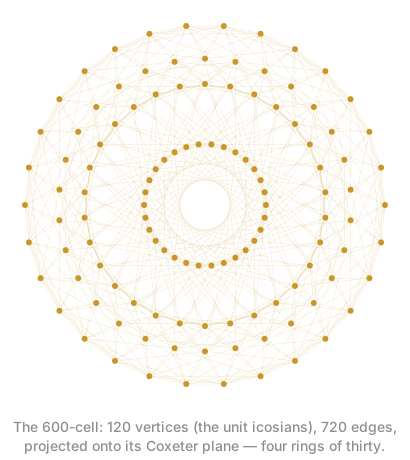
The four concentric rings of thirty are the shadow of a genuinely four-dimensional object; no three-dimensional solid projects to anything so regular. Its dual - swap vertices for cells - is the even larger 120-cell, built from dodecahedra.
\(H_4\), and a tower of golden symmetry
Every regular polytope has a symmetry group generated by mirror reflections, a reflection group.1 The 600-cell's is called \(H_4\), and it is enormous: 14400 symmetries. What makes \(H_4\) special is that it is non-crystallographic - it cannot be the symmetry group of any lattice, any repeating grid, in any dimension.3 The obstruction is exactly the golden ratio: a lattice can only have 2-, 3-, 4-, and 6-fold rotational symmetry (the old crystallographers' theorem), never 5-fold, and \(H_4\) is shot through with fives.
\(H_4\) sits at the top of a short tower, each floor the symmetry group of a golden shape one dimension below the next:
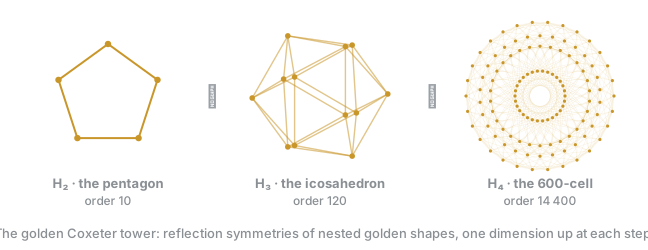
The pentagon's symmetry (\(H_2\)), the icosahedron's (\(H_3\))2, the 600-cell's (\(H_4\)) - a nested family \(H_2 \subset H_3 \subset H_4\), all non-crystallographic, all golden, and all built from the same \(\sqrt5\) that has run through this whole series. The tower stops at \(H_4\): there is no non-crystallographic \(H_5\). Four dimensions is where the golden symmetry runs out.
Folding \(E_8\) onto the 600-cell
Now let's explore the connection between the roots of \(E_{8}\) and the 600-cell.
The two finite groups \(H_4\) and \(E_8\) share the same Coxeter number. It's a single integer attached to each reflection group that considers all reflections at once and measures how these combined reflections amount to a rotation. In the present case, its generators wind around \(30\) times for both \(H_4\) and \(E_8\).4 That is not a coincidence; it is the visible tip of a precise relationship called a folding.
Here is the relationship, stated all at once. The \(E_8\) root picture that opened the last post was eight rings of thirty. The 600-cell picture that opened this one is four rings of thirty. The folding says: eight is four plus four. Project \(E_8\)'s eight dimensions down to the right four, and its \(240\) roots land exactly on two concentric 600-cells, their sizes in the golden ratio:
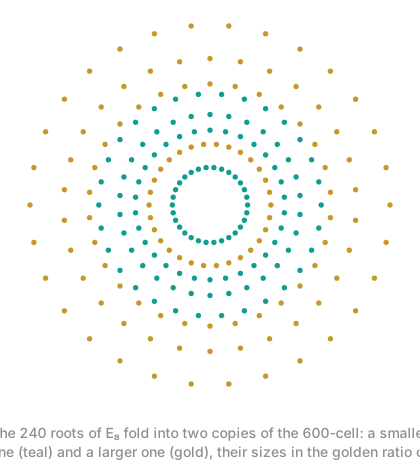
This is the very picture that opened the last post - the same \(240\) points, in the same projection - recolored by which 600-cell each root belongs to: four of the eight rings teal, four gold, each teal radius paired with a gold radius exactly \(\phi\) larger. The rest of this section unpacks what "the right four" means, and why the answer had to be two golden 600-cells.
Recall what the last post built - both of its ingredients, because the fold uses both. First, the embedding: every icosian was read twice, its four golden coordinates evaluated once at \(\phi\) and once at the Galois conjugate \(\phi'\), giving a point of eight-dimensional space
Second, the metric: on those eight coordinates the post did not measure length the everyday way, but with the twisted form
and it was with this form - not before - that the icosian ring became \(E_8\).
One remark on where those weights live, because there are two equivalent ways to hold them, and the difference is worth making explicit. As written, the weights sit in the metric: the point is \((q,\ q')\), and \(Q\) decides what length means. But you can just as well pull them into the coordinates - record the rescaled point
and measure with the ordinary Euclidean ruler: the everyday squared length of the rescaled point is \(Q\). In these coordinates the icosians form an honest lattice sitting in everyday \(\mathbb{R}^8\), and that lattice is \(E_8\) in the textbook sense. Same construction, with the bookkeeping moved from the ruler to the grid - and notice that the relative stretch between the two blocks is exactly \(\phi\), golden even here. Nothing below depends on the choice: the fold acts block by block, and within a block the rescaling is a single overall factor, so every ratio we care about survives untouched. We will keep drawing in the plain \(q\)-coordinates.
Now look at the anatomy of the form. The eight coordinates fall into two blocks of four - the \(\phi\)-block \(q\) and the \(\phi'\)-block \(q'\) - and \(Q\) is an ordinary squared length on each block, with no cross terms between them. So the two copies of \(\mathbb{R}^4\) are orthogonal to one another even in the twisted metric; all the twist does is weigh the blocks unequally, \(1/\phi\) on the first and \(\phi\) on the second. Two orthogonal four-dimensional spaces, each with its own golden weight - and the 600-cell is a four-dimensional solid.
The fold is the orthogonal projection onto the first block - keep the four \(\phi\)-coordinates, discard the four conjugate ones:5
Now the roots. The last post computed exactly what the \(240\) shortest vectors are: the \(120\) unit icosians, of quaternionic norm \(|q|^2 = 1\), together with \(\phi\) times the \(120\) unit icosians, of norm \(\phi^2\). Apply \(\pi\) and there is nothing left to do. The units land on the unit quaternions - the 600-cell, at radius \(1\): teal. The golden copies land on \(\phi\) times that same 600-cell, at radius \(\phi\): gold. Two concentric 600-cells - radii in ratio exactly \(\phi\), squared lengths in ratio \(\phi^2\). \(240 = 120 + 120\): the folding and the last post's root count are the same sentence, read in two directions.
Note what the two 600-cells are, and are not. They are the two distinct families of roots - the units and their \(\phi\)-multiples - and both land in the same four dimensions; there is not one cell per conjugate.
Project onto the \(\phi'\)-block instead and the same two families reappear inside out: the units again at radius \(1\), the golden family now shrunk to radius \(1/\phi\), because the conjugate of \(\phi\) is \(-1/\phi\). In \(E_8\)'s own metric, in fact, there was never a big cell and a small cell at all - every root has \(Q = 2\); that is what being a root means. Which family looks enlarged is decided entirely by which conjugate you read.7
So one of the most exceptional lattice in mathematics, projected down to four dimensions, is nothing but two of our golden solids nested by the golden ratio. The 600-cell was hiding inside \(E_8\) the whole time - twice. And it was the icosians, all along, that were the 600-cell.
A Quasicrystal Interpretation of the Fold
Non-crystallographic symmetry sounds like a defect - the shapes that can't tile space - but it is exactly what makes quasicrystals possible: real materials that show sharp five-fold diffraction, ordered but never repeating. And their mathematics is not merely like the folding we just did. It is the same map.
The recipe is called cut-and-project. Take a lattice in some high-dimensional space; split that space into a physical part and an internal part; keep only those lattice points whose image in the internal part falls inside a chosen window; project the survivors onto the physical part. What drops out is quasiperiodic - it's ordered but never repeating.
Now consider the relationship between the \(E_8\) lattice's minimal vectors and the 600-cell: Physical space and internal space are the standard names for the two halves of such a split, and our two blocks are exactly that: the \(\phi\)-block is the physical space, the \(\phi'\)-block the internal space.
And the window? First see why one is needed at all. The fold discards no lattice point - it forgets the conjugate, it does not select on it - and it collides none: \(1\) and \(\phi\) are rationally independent, so the real number \(a + b\phi\) pins down \(a\) and \(b\), \(q\) remembers \(q'\), and \(\pi\) is injective on the whole ring. So project the whole icosian ring and nothing is lost, nothing overlaps - and the image is a dense golden fog in \(\mathbb{R}^4\), because \(\mathbb{Z}[\phi]\) is dense in \(\mathbb{R}\).6 Projection alone cannot produce a crisp picture. A window can.
Roots and the Window
Ours was "being a root." A root means \(Q(q) = 2\), which unpacked says
and since both terms are positive, each is capped: \(|q| \le 1.902\ldots\) and, crucially, \(|q'| \le 1.176\ldots\) - a bound on the internal coordinates, the very ones the fold discards. As a region of internal space, then, the window is the closed ball
its radius the largest internal size the root equation permits, reached as \(|q| \to 0\).
One point deserves stating exactly, because it is the mechanism. The ball \(W\) is necessary but not sufficient: on its own it also admits longer vectors: the norm-\(Q=4\) icosian \(\phi^{2}\cdot(\text{unit})\), say, whose conjugate lands at
well inside \(W\).
What selects exactly the \(240\) is the minimal-norm condition \(Q(q) = 2\) itself; \(W\) is merely that shell's shadow on internal space, and the roots meet it at only two radii, \(|q'| = 1\) (teal) and \(|q'| = 1/\phi\) (gold). So "the roots are our window" is shorthand for \(W\) together with minimal norm.
That cap is the only reason the fold produced \(240\) tidy points rather than the fog. We did not do something like cut-and-project. We did cut-and-project, with the roots - the ball \(W\) and that pinch of minimal norm - as our window.
The recipe also needs one structural condition, and golden arithmetic hands it over for free: no nonzero icosian projects to zero in either factor. Conjugation is a field automorphism, so \(q' = 0\) forces \(q = 0\), and the lattice touches neither \(\mathbb{R}^4\) anywhere but the origin. It lies across the split at a totally irrational angle, and it could not do otherwise. Drop the minimal-norm restriction, hand the choosing to a fatter window that selects across every shell, and the points stop being a polytope and start being a quasicrystal - same lattice, same split, same map.
That irrationality is the entire mechanism. Had \(E_8\) split cleanly into a \(\phi\) half and a \(\phi'\) half - had \((q, 0)\) and \((0, q')\) been points of the lattice - the projection would come out periodic, the diffraction ordinary, and there would be no Shechtman. A quasicrystal can exist for the same reason \(\phi\) has a conjugate it can never quite shake off. The discovery won a Nobel Prize in 2011.8
Past the roots: a tiling
The roots were a single shell caught in a razor-thin window. Fatten that window - take a solid region of internal space, not just the boundary of \(W\) - and keep every lattice point whose conjugate falls inside it, across all the norm shells at once. The projection stops landing on two clean 600-cells and instead fills \(\mathbb{R}^4\) with a discrete, gap-free, never-repeating cloud of points. That is a genuine quasicrystal, and it carries an aperiodic tiling: decorate the cloud and \(\mathbb{R}^4\) tiles with a finite kit of prototiles, the 600-cell recurring throughout as a local cluster.
None of this is loose analogy. Projecting \(E_8\) into four dimensions through the icosian ring is a named object - the Elser-Sloane quasicrystal - and the icosian route to it is laid out in Moody and Patera's Quasicrystals and Icosians.9 It carries the full \(H_4\) symmetry of the 600-cell, and it is the four-dimensional sibling of the Penrose tiling of the plane (cut and projected from \(\mathbb{Z}^5\)) and the icosahedral tilings of ordinary space (from \(\mathbb{Z}^6\)). The two 600-cells you drew are the seed; loosen the window and the whole aperiodic crystal grows out of the same golden fold.
We have now seen the icosians wearing all their hats: a golden ring of quaternions, the symmetries of the icosahedron, the group \(2\cdot A_5\), the vertices of the 600-cell, the reflection group \(H_4\), and the seed of \(E_8\). Six faces of 120 numbers. The thread tying every one of them together is a single quadratic equation, \(\phi^2 = \phi + 1\) - which is where this series began.
-
A reflection group is a group of symmetries generated by mirror reflections. For the regular polytopes these are the Coxeter groups; \(H_4\) is the one attached to the 600-cell (and to its dual the 120-cell). ↩
-
These orders count the full symmetry - reflections included. The icosahedron has \(60\) rotations but \(120\) symmetries in all, so \(H_3\) has order \(120\). Note this \(H_3\) (rotations and reflections) is a different group from the binary icosahedral \(2\cdot A_5\) of the earlier posts, even though both have order \(120\) - same size, different structure. ↩
-
A crystallographic group is one that preserves some lattice. The crystallographic restriction theorem says a lattice symmetry can have rotational orders only \(2, 3, 4, 6\) - never \(5\). Because \(H_4\) contains 5-fold rotations, no lattice in any dimension has \(H_4\) symmetry; this is what "non-crystallographic" means. (It is also why \(E_8\), which is a lattice, meets \(H_4\) only through a projection, never as an equal - see the folding below.) ↩
-
The Coxeter number \(h\) of a reflection group governs, among other things, how its roots project onto the "Coxeter plane": they fall into rings of \(h\) points. That both \(E_8\) and \(H_4\) have \(h = 30\) is why the \(E_8\) picture (8 rings of 30) and the 600-cell picture (4 rings of 30) rhyme - and why one folds onto two of the other. ↩
-
Written out in coordinates, \(\pi\) is a \(4 \times 8\) matrix whose columns are the eight basis quaternions of the icosian ring, each read at the \(\phi\) place; every entry lands in \(\tfrac12\mathbb{Z}[\phi]\). It depends on which basis of the ring you happen to pick - any other choice conjugates it. And it takes the icosian model of \(E_8\) as its starting point: from \(E_8\) in textbook coordinates, you would compose with the isometry onto the icosian model first. ↩
-
This is the same fact as \(\phi\) being irrational, wearing a hat. The numbers \(a + b\phi\) with \(a, b\) integers can be made to land as close to any target as you like - take \(\mathbb{Z}[\sqrt2]\) and its conjugate embedding if you want to watch it happen: the lattice \(\{(a + b\sqrt2,\ a - b\sqrt2)\}\) never once meets the horizontal axis away from the origin, and yet its projections onto that axis have gaps shrinking past \(10^{-4}\) by the time you allow coefficients up to a thousand. Never touching and landing everywhere are perfectly compatible. ↩
-
More is true: every root obeys \(|q|\,|q'| = 1\) exactly, so squeezing one conjugate inflates the other, and the \(240\) roots ride the hyperbola \(|q|\,|q'| = 1\) - the two 600-cells are the only two stations on it that golden arithmetic permits. Why: \(|q|^2|q'|^2\) is the ordinary integer norm of the golden number \(|q|^2\), and a root's quaternionic norm is forced to be a unit of \(\mathbb{Z}[\phi]\) - either \(1\) or \(\phi^2\), both of norm one. That is the same computation as the last post's: the shortest vectors are exactly the icosians of norm \(1\) and norm \(\phi^2\), which is where \(240 = 120 + 120\) came from. ↩
-
Dan Shechtman, for the discovery of quasicrystals; Nobel Prize in Chemistry, 2011. The mathematical model - a slice or projection of a higher-dimensional periodic lattice - is due to work of de Bruijn, Penrose, and others in the preceding decade. ↩
-
V. Elser and N. J. A. Sloane, "A highly symmetric four-dimensional quasicrystal," J. Phys. A: Math. Gen. 20 (1987) 6161; R. V. Moody and J. Patera, "Quasicrystals and icosians," J. Phys. A: Math. Gen. 26 (1993) 2829. ↩