The icosian series was built on the golden ring \(\mathbb{Z}[\phi]\) - the integers with a fifth-root-of-unity flavor, the arithmetic of the icosahedron's five-fold symmetry. But five is the exotic case. Step down, to four-fold and three-fold symmetry - the cube and the tetrahedron - and you meet two rings that come earlier and cut deeper: the Gaussian and Eisenstein integers. They are the first two rings of numbers a number theorist reaches for after the ordinary integers \(\mathbb{Z}\), and this post is about how they work.
The pattern to hold onto: a rotational symmetry of order \(n\) is governed by an \(n\)th root of unity, and adjoining that root to \(\mathbb{Z}\) builds a ring.
- four-fold (the square, the cube): \(\ i = e^{2\pi i/4}\), giving the Gaussian integers;
- three-fold (the triangle, the tetrahedron): \(\ \omega = e^{2\pi i/3}\), giving the Eisenstein integers;
- five-fold (the pentagon, the icosahedron): \(\ \phi\), giving the golden ring - the one we already know.2
The Gaussian integers
Adjoin \(i = \sqrt{-1}\) to the integers. The result is the Gaussian integers,
the square lattice in the complex plane. It is a ring - closed under addition and multiplication, since \((a+bi)(c+di) = (ac-bd) + (ad+bc)i\) stays inside it.
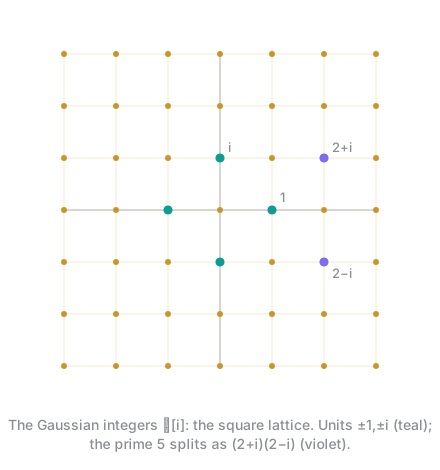
Two features make it feel like a bigger copy of \(\mathbb{Z}\). First, its units - the elements with a multiplicative inverse inside the ring - are exactly \(\{1, i, -1, -i\}\), the four fourth roots of unity. (That count, four, is the four-fold symmetry of the square lattice, and of the cube.) Second, and more remarkably, \(\mathbb{Z}[i]\) has unique factorization: every Gaussian integer breaks into Gaussian primes in essentially one way, just as ordinary integers factor into ordinary primes.1
But the primes reshuffle. Measuring size by the norm \(N(a+bi) = a^2 + b^2\), watch what happens to the ordinary primes:
- \(5 = (2+i)(2-i)\) - it splits, no longer prime once \(i\) is available;
- \(13 = (3+2i)(3-2i)\), \(17 = (4+i)(4-i)\) - likewise;
- \(3, 7, 11, 19\) - these stay prime (they are inert);
- \(2 = -i\,(1+i)^2\) - a special case, it ramifies.3
The rule is beautifully clean: an odd prime \(p\) splits exactly when \(p \equiv 1 \pmod 4\), and stays prime when \(p \equiv 3 \pmod 4\). Since a prime splits in \(\mathbb{Z}[i]\) - as \(p = (a+bi)(a-bi) = a^2 + b^2\) - precisely when it is a sum of two squares, this is Fermat's theorem on sums of two squares - \(p\) is a sum of two squares iff \(p = 2\) or \(p \equiv 1 \pmod 4\) - falling out as a fact about factoring in \(\mathbb{Z}[i]\).
The Eisenstein integers
Now adjoin a cube root of unity instead. Let \(\omega = e^{2\pi i/3} = \tfrac{-1 + \sqrt{-3}}{2}\), the root of \(\omega^2 + \omega + 1 = 0\). The Eisenstein integers are
and because \(\omega\) sits at \(120^\circ\), they form the triangular lattice - the tightest way to pack points (or coins) in the plane.
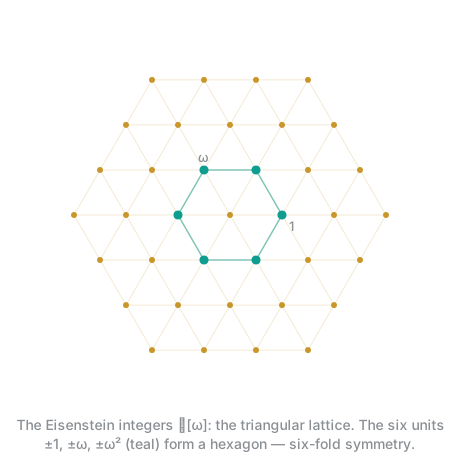
Here the units are the six sixth roots of unity, \(\{\pm 1, \pm\omega, \pm\omega^2\}\), arranged as a perfect hexagon - the six-fold symmetry of the triangular lattice (and the three-fold symmetry of the tetrahedron, doubled). Like the Gaussian integers, \(\mathbb{Z}[\omega]\) enjoys unique factorization, with its own norm \(N(a+b\omega) = a^2 - ab + b^2\).
The primes split by a different clock - modulo \(3\) instead of \(4\):
- \(p \equiv 1 \pmod 3\) splits: \(7 = (3+\omega)(3+\bar\omega)\), since \(3^2 - 3 + 1 = 7\);
- \(p \equiv 2 \pmod 3\) stays prime: \(2, 5, 11, 17, \dots\);
- \(3 = -\omega^2\,(1-\omega)^2\) ramifies - the special prime, as \(2\) was for the Gaussians.
Same story, different modulus. And that is the whole point: which root of unity you adjoin decides which arithmetic you get. Four-fold symmetry sorts primes by their residue mod \(4\); three-fold symmetry sorts them mod \(3\).
Why only these - and why the icosahedron is different
Step back and the three rings line up by their units, which are just roots of unity sitting on a circle:
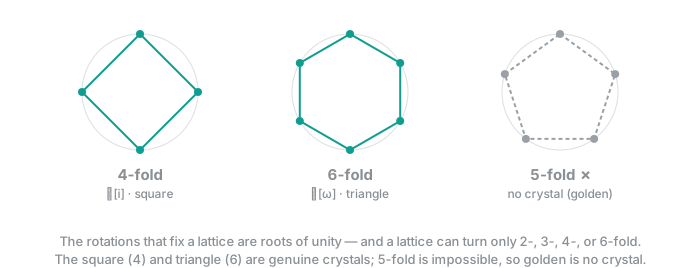
The Gaussian units make a square, the Eisenstein units a hexagon - and those are exactly the rotations those lattices can have. This is no accident. The crystallographic restriction: a rotation by \(2\pi/n\) preserves some lattice only when its trace \(2\cos(2\pi/n)\) is an ordinary integer, and that happens only for \(n = 1, 2, 3, 4, 6\). Four-fold and six-fold are in; the square and the triangle are genuine crystals, which is why \(\mathbb{Z}[i]\) and \(\mathbb{Z}[\omega]\) sit so comfortably as flat lattices in the plane.
Five-fold is not on the list. \(2\cos(2\pi/5) = \phi - 1\) is irrational, so no lattice can turn by a fifth of a circle - which is exactly why the golden ring is the odd one out. \(\mathbb{Z}[\phi]\) is real, not a lattice in the complex plane at all; to house five-fold symmetry you have to leave the plane, climb to four dimensions, and use quaternions - which is the whole story of the icosians. Gaussian and Eisenstein are the two rings that do tile the plane; golden is the rebel that can't, and that rebellion is what makes it interesting.
Where this goes
The mod-\(4\) and mod-\(3\) splitting laws are the first two entries of one of the deepest patterns in number theory. Behind a rotation sits a quadratic field \(\mathbb{Q}(\sqrt{d})\) - nested inside the cyclotomic field its root of unity generates - and the primes rearrange themselves according to it: four-fold gives \(\mathbb{Q}(i)\), three-fold gives \(\mathbb{Q}(\sqrt{-3})\), five-fold gives \(\mathbb{Q}(\sqrt5)\), seven-fold gives \(\mathbb{Q}(\sqrt{-7})\).4 Each is a self-contained little arithmetic with its own units, its own primes, its own factorization - and picking which one you live in is as simple as choosing a rotation. We will need this dictionary again.
-
Both rings are Euclidean domains - they support division-with-remainder measured by the norm, and that, exactly as for \(\mathbb{Z}\), forces unique factorization into primes. Not every ring of algebraic integers is so well-behaved; \(\mathbb{Z}[i]\) and \(\mathbb{Z}[\omega]\) are among the fortunate ones (they have class number one). ↩
-
A slight abuse: \(\phi\) is not itself a root of unity. The genuine fifth root is \(\zeta_5 = e^{2\pi i/5}\), and adjoining it gives the four-dimensional cyclotomic ring \(\mathbb{Z}[\zeta_5]\); the golden ring \(\mathbb{Z}[\phi]\) is only its real part (the maximal real subring, fixed by complex conjugation). That collapse from four complex dimensions down to one real line is exactly why five-fold is the odd case here - worked out in "Why only these" below. ↩
-
The third fate of a prime, alongside splitting into distinct primes and staying inert. A prime ramifies when its factorization carries a repeated prime factor - here \(2 = -i\,(1+i)^2\), the Gaussian prime \(1+i\) squared. It happens only at the primes dividing the ring's discriminant, which is why \(\mathbb{Z}[i]\) and \(\mathbb{Z}[\omega]\) have exactly one apiece: \(2\) and \(3\) respectively. ↩
-
The conspicuous omission is eight-fold, and it is the golden case's closest cousin. The octagon's number is the silver ratio \(\delta = 1 + \sqrt2\), and its ring \(\mathbb{Z}[\sqrt2]\) - the real part of \(\mathbb{Q}(\zeta_8)\) - is what the eight-fold Ammann–Beenker quasicrystal is built on, just as the golden ring underlies Penrose's five-fold one. It sits a little apart from the list for two reasons: \(\mathbb{Q}(\zeta_8)\) is the first cyclotomic field with several quadratic subfields - \(\mathbb{Q}(i)\), \(\mathbb{Q}(\sqrt2)\), \(\mathbb{Q}(\sqrt{-2})\) - so "eight-fold \(\to\) one field" is already a choice; and its ramified prime is \(2\), which ramifies wildly, the same delicacy we met when \(2 = -i(1+i)^2\). ↩