In an earlier post we saw how the icosian ring turned out to be the \(E_8\) lattice. An icosian has four coordinates in the golden ring \(\mathbb{Z}[\phi]\); each can be read as a real number in two ways, once with \(\phi = 1.618\ldots\) and once with its conjugate \(\phi' = -0.618\ldots\). With the right framing, the four golden dimensions become eight real ones, and the result is the \(E_8\) lattice1.
The \(E_8\) lattice is exceptional for a number of reasons, and it is the unique even unimodular lattice in eight dimensions. Famously, even, unimodular lattices can only exist in \(8k\)-dimensions, so the next natural place to look is sixteen, where there are two such lattices. And both of these lattices define distinct manifestations of the heterotic gauge bundle in String Theory.
Why sixteen
The heterotic string is the famous chimera: its left-moving modes are those of the \(26\)-dimensional bosonic string, its right-moving modes those of the \(10\)-dimensional superstring, glued into one object.2 That leaves
left-moving dimensions with nowhere to go. The resolution is to roll them up - to compactify them on a torus \(\mathbb{R}^{16}/\Lambda\) for some lattice \(\Lambda\).
You do not get to pick \(\Lambda\) freely. Consistency of the string - modular invariance of its one-loop amplitude - forces \(\Lambda\) to be even and unimodular: exactly the condition \(E_8\) satisfies in dimension \(8\). And here the mathematics closes the door almost immediately. Even unimodular lattices exist only in dimensions divisible by \(8\), and in dimension \(16\) there are exactly two:
Two lattices, so two heterotic strings - and that is the whole reason there are two.4 The first is just two copies of \(E_8\) side by side. The second, \(D_{16}^+\), is built from the checkerboard lattice \(D_{16}\) (integer vectors with even coordinate sum) together with one extra spinor class, the translate by \((\tfrac12, \tfrac12, \ldots, \tfrac12)\).
The physics reads the lattice's roots - its shortest vectors, of squared length \(2\) - as gauge bosons. Both lattices have \(480\) of them, and both have rank \(16\) worth of Cartan directions, so both give a gauge group of dimension
namely \(E_8 \times E_8\) and \(\mathrm{Spin}(32)/\mathbb{Z}_2\). Two lattices, two gauge groups, two strings.
So the question this post is about is short: the icosians reached \(E_8\) in dimension \(8\). In dimension \(16\), which of the two do they reach?
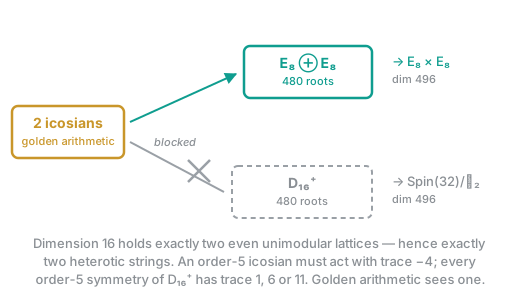
One of them is free
\(E_8 \oplus E_8\) costs nothing. Take two icosians instead of one, do not impose any relation between them, and unfold each through its two golden readings exactly as before. Two independent icosians, two independent copies of \(E_8\). There is no cleverness in it at all - but it does mean the answer to "can the icosians reach dimension \(16\)?" is yes, trivially.
The real question is the other one.
Of course, the \(E_{8}\) lattice is the \(D_{8}^{+}\) lattice precisely3. So you might think a similar doubling trick might give us \(D_{16}^{+}\).
The other fails
The short answer is no - and the reason turns out to have almost nothing to do with lattices. It is about symmetry, and about a clash the reader of this series has already met.
The icosians are fivefold symmetry: their \(120\) units are the binary icosahedral group \(2\cdot A_5\).
Any lattice carrying an icosian structure carries those \(120\) rotations with it7. But \(D_{16}^+\) lives in a crystallographic world; its symmetries are nothing more than signed permutations of the sixteen coordinates8.
A world of coordinate permutations has no room for a fivefold rotation. That is the crystallographic restriction, the same rebel obstruction that made \(H_4\) non-crystallographic in the last post.5 An icosian structure on \(D_{16}^+\) would smuggle a fivefold rotation into a lattice that forbids one.
Everything below is just watching the two sides fail to meet, in a single number: the trace of the order-\(5\) rotation.
What the icosians force.
Ask how a fivefold unit icosian must act, and its trace on \(\mathbb{R}^{16}\) comes out negative - a golden number that works out to exactly9
What \(D_{16}^+\) allows. Ask what an order-\(5\) signed permutation can do, and its trace is only a count of fixed axes - it is forced into10
Never negative, never close. So the two demands cannot both be met:
So \(D_{16}^+\) cannot carry the icosians, and \(E_8 \oplus E_8\) is the only even unimodular lattice in dimension \(16\) with golden arithmetic on it.
Why this spares \(E_8\). An argument this cheap should make you nervous: \(E_8\) is itself \(D_8^+\), so why doesn't the very same clash forbid it? This is the twist, and it is the whole mechanism. In dimension \(8\) the spinor class is shorter - squared length \(8 \times \tfrac14 = 2\), exactly root length - so \(D_8^+\) picks up \(128\) roots that \(D_8\) never had (\(112 + 128 = 240\)), its root lattice is \(E_8\), and its symmetry group swells from mere signed permutations all the way to the Weyl group of \(E_8\). That group is vast, non-crystallographic enough to hold a fivefold rotation, and it produces the required trace \(-2\) without blinking. It all comes down to one thing: whether the spinor class reaches root length. In dimension \(16\) it overshoots and the door stays shut; in dimension \(8\) it lands exactly on root length and the door swings open.
The icosians pick a string
Put it together. The golden ratio, which showed up because a Platonic solid has fivefold symmetry, reaches into dimension \(16\), finds the two consistent heterotic strings sitting there, and sees exactly one of them.
The obstruction is fivefold symmetry itself. What kills \(D_{16}^+\) is the order-\(5\) element - and \(D_{16}^+\)'s symmetries are permutations of coordinates, which is a crystallographic world, one that has no room for a fivefold rotation with a golden trace.5 \(E_8 \times E_8\) is the heterotic string that the icosahedron can see.
It should be noted that string theory is perfectly happy with both, and \(\mathrm{Spin}(32)/\mathbb{Z}_2\) is not sick. It is a statement about which of the two admits a particular piece of arithmetic. This is a selection rule for personal preference, and perhaps some downstream studies. But it is a clean one, and it is the kind of statement I find worth having: an arithmetic selection rule sitting on top of a physical dichotomy that physics itself does not break.
-
Here we are being loose with terminology that was made precise in the previous post. The idea is that the icosian ring is a rank-8 \(\mathbb{Z}\)-module which we then embed in \(\mathbb{R}^{8}\). ↩
-
Gross, Harvey, Martinec and Rohm, Heterotic string theory, 1985. The name is theirs, from the biological heterosis - hybrid vigour. ↩
-
The Lie algebra so(16) associated with the \(D_{8}^{+}\) lattice has dimension 120. The Lie algebra \(e_8\) has dimension \(248\). The discrepancy comes from including the spinor representations of \(so(16)\) natively into the algebra, which gives the extra \(128\)-dimensions. ↩
-
The classification of even unimodular lattices in dimension \(16\) (there are two) is due to Witt, and the general theory to Kneser. That this is exactly the classification of heterotic strings in ten dimensions is one of the tidier coincidences in mathematical physics: a lattice theorist finished the job decades before anyone asked the physics question. ↩
-
This is the crystallographic restriction again - the same obstruction that makes fivefold symmetry impossible for a two- or three-dimensional crystal, and that forced the icosians to be quaternions in the first place. See the Gaussian and Eisenstein post. Fivefold symmetry is the rebel, and here it is refusing a coordinate lattice one more time. ↩↩
-
The Strominger system. Torsional heterotic compactifications have been studied since Strominger and Hull in 1986, and remain much less understood than their Calabi–Yau cousins - which is most of their appeal. ↩
-
An icosian structure on the \(16\)-dimensional lattice means presenting it as a rank-\(2\) module over the icosian ring: its elements are pairs \((q_1, q_2)\) of icosians, each unfolding through the two golden readings into an \(\mathbb{R}^8\) exactly as a single icosian did, together filling \(\mathbb{R}^{16}\). Every unit icosian \(u\) has norm \(1\), so multiplying both coordinates by it, \((q_1, q_2) \mapsto (u q_1, u q_2)\), is an isometry of the lattice - and this is how the \(120\) units embed into its symmetry group. The trace we compute is the character of that \(16\)-dimensional representation. ↩
-
\(D_{16}^+\) is the checkerboard lattice \(D_{16}\) (integer vectors of even coordinate sum) together with one spinor class, the translate by \((\tfrac12, \ldots, \tfrac12)\). That class has squared length \(16 \times \tfrac14 = 4\), longer than a root, so it holds no roots: all \(480\) roots sit in \(D_{16}\), every symmetry must permute them, and that pins the symmetry group down to signed coordinate permutations - with an even number of sign flips, so the spinor class survives. ↩
-
A single unit icosian \(u\) acts on one quaternion block \(\mathbb{H} \cong \mathbb{R}^4\) by left multiplication, eigenvalues \(e^{\pm i\theta}\) each occurring twice; its reduced trace \(2\cos\theta\) lies in \(\mathbb{Z}[\phi]\), so it has two golden readings. Three factors carry this to \(\mathbb{R}^{16}\): the doubled eigenvalues give a \(2\), the second icosian another \(2\), and the two golden places add rather than multiply - so the trace is \(4\) times the sum of the two readings of \(2\cos\theta\). For \(u\) of order \(5\) the reduced trace is \(-\phi'\) (equivalently \(-\phi\)), the readings sum to \(-\phi' - \phi = -1\), and \(4 \times (-1) = -4\). ↩
-
An order-\(5\) signed permutation has cycles of length \(1\) or \(5\); each \(5\)-cycle contributes trace \(0\) and each fixed coordinate \(+1\), so the trace is just the number of fixed coordinates. With \(16 = 5a + b\) that count \(b\) can only be \(1\), \(6\), or \(11\) - never negative. ↩